I really enjoyed our ‘Edcamp’ model of learning today. I think it would absolutely be something I could use in my future classrooms as a discussion or sharing tool. My teachable is social studies so using Edcamp could absolutely be helpful in facilitating student ideas and conversations. I liked that the model encourages participants to move around and get a wider variety of conversations rather than just one.
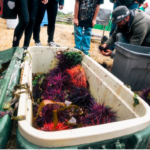
I was mostly in the discussion focused on incorporating nature into learning. I think this ties in nicely with my free inquiry project on marine biology- even though I’m not in the sciences, I’ll never know what I’ll wind up teaching one day. If I do stay in BC for teaching, I would absolutely love the ability to integrate teaching into being outdoors. Getting students to explore and study tide pools would be incredibly fun – they could even use the ‘Edcamp’ model afterwards to discuss what they saw. Although I feel more comfortable in socials, it would be really interesting to see if I could tie in marine biology somehow with geography or social studies- room to explore the idea of co-teaching and cross-curricular learning!
During our discussion on nature, those who have experience with youth and nature brought forward the important point of trying to engage kids who don’t want to be there/are tied to their phones. I feel like this is tricky to navigate- phones can be used as tools when integrating teaching and the outdoors, as they can use their cameras to document findings or use apps for identification of species. On the other side, there’s the opportunity for kids to only view nature through the lens of their phone and not actually absorb what they’re experiencing and the beauty of where they are. This could possibly be solved by having ‘phone free’ outdoor classes, but it might be like pulling teeth to get teens to leave their phones at school or in their pockets. One of my colleagues in the program mentioned that a student she worked with thanked her for getting the students to put away their phones during an outdoor ed lesson, which was nice to hear as there is some hope that teens are recognizing how tied they are to phones. Only time will tell as I start to hopefully witness outdoor integration at my future placements and in my future classes which methods work best in engaging students and leaving an impact.